
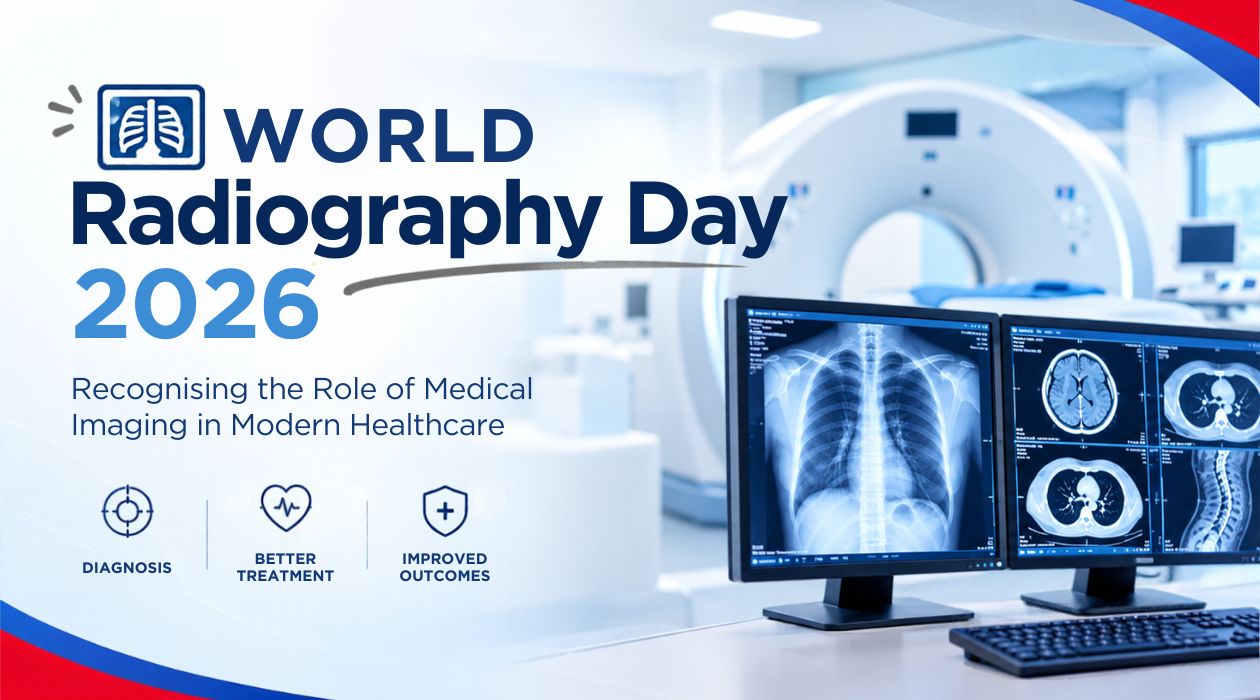
World Radiography Day is observed annually on 8 November to commemorate the discovery of X-rays by German physicist Wilhelm Conrad Röntgen on 8 November 1895. This discovery marked a significant milestone in medical science, enabling healthcare professionals to examine internal structures of the human body without the need for exploratory surgery.
Today, medical imaging is an essential component of modern healthcare, supporting the diagnosis, assessment and monitoring of various medical conditions. Advances in imaging technology have enabled healthcare professionals to obtain detailed images of the body’s internal structures, helping doctors make informed clinical decisions and determine appropriate treatment plans.
The Importance of Medical Imaging
Medical imaging encompasses several techniques, including conventional X-rays, computed tomography (CT) scans, magnetic resonance imaging (MRI) and mammography. Each technique serves a different clinical purpose, depending on the patient’s symptoms, medical history and diagnostic requirements.
X-rays are commonly used to assess bone fractures, chest conditions and other abnormalities. CT scans provide detailed cross-sectional images of the body, supporting the evaluation of injuries and complex medical conditions. MRI uses magnetic fields and radio waves to produce detailed images of soft tissues, the brain, spinal cord and joints.
Mammography is a specialised imaging examination that uses low-dose X-rays to examine breast tissue. It plays an important role in breast cancer screening and may also be used to investigate breast symptoms or abnormalities, depending on clinical assessment. Regular screening, when appropriate for an individual’s age and risk factors, can help detect breast cancer at an earlier stage.
Radiology Services at Putra Medical Centre, Alor Setar
At Putra Medical Centre (PMC), Alor Setar, Kedah, radiology services support the diagnostic needs of patients through medical imaging examinations, including X-rays, CT scans, MRI and mammography.
PMC also provides mammogram services to support breast health assessment and the detection of abnormalities in breast tissue. These examinations can assist doctors in evaluating breast conditions and determining whether further investigation or treatment is required.
The availability of different imaging modalities enables doctors to select appropriate examinations according to each patient’s clinical needs. The choice of imaging procedure depends on factors such as the suspected condition, the information required for diagnosis and the doctor’s recommendation.
The Role of Radiographers in Patient Care
Radiographers are important members of the healthcare team. Their responsibilities include preparing and positioning patients, operating imaging equipment, producing diagnostic-quality images and ensuring that appropriate safety procedures are followed throughout the examination.
For procedures involving ionising radiation, such as X-rays, CT scans and mammography, radiation protection principles are applied to ensure that examinations are clinically justified and radiation exposure is optimised. MRI, on the other hand, does not use ionising radiation.
Radiographers also play an important role in patient communication by explaining examination procedures, addressing concerns and helping patients feel comfortable during imaging examinations. Their technical knowledge, attention to detail and adherence to safety protocols contribute to the quality and reliability of medical imaging.
Radiographers work closely with radiologists and other healthcare professionals. Radiologists are medical doctors who interpret medical images and provide diagnostic findings that assist in patient management.
Recognising the Contribution of Medical Imaging Professionals
As medical technology continues to advance, radiography remains an important part of modern diagnostic practice. The combination of appropriate imaging technology, skilled professionals and clinical expertise supports the accurate assessment of medical conditions and helps guide patient care.
In conjunction with World Radiography Day 2026, Putra Medical Centre recognises the contribution of radiographers and medical imaging professionals in supporting diagnostic services and patient care. Their commitment to professional practice, patient safety and quality imaging plays an important role in the delivery of healthcare services.
For enquiries about radiology services, including mammogram examinations, at Putra Medical Centre, Alor Setar, please contact 04-734 2888 (Ext 1111).